


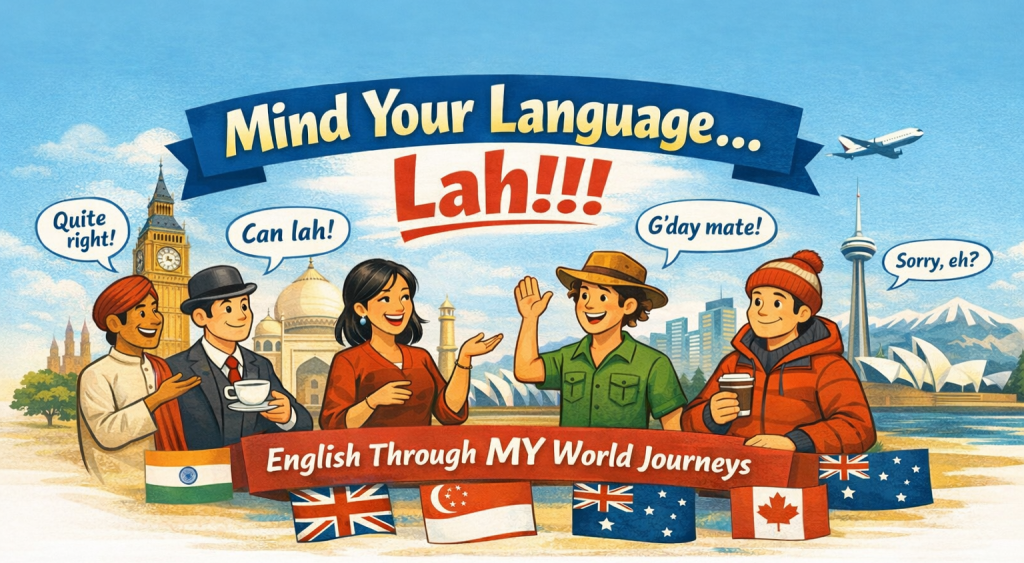
I thought English was… well… English.
Until life took me on a global journey—through Indian English, British English, Singapore English, Australian English… and now Canadian English.
Somewhere along the way, English stopped being just a language… and became a cultural experience—something you learn not just to communicate, but to belong.
As Toastmasters, we often focus on speaking clearly. But sometimes, the bigger challenge is understanding what people really mean—even when they are speaking the same language.
Where It All Began — My Indian English Foundation
Growing up in India, we took English very seriously.
We spoke “The Queen’s English”… which is now “The King’s English,” of course.
We don’t “go to the office.” … We “reach the venue.”
We don’t “finish a task.” … We “do the needful.”
I genuinely believed this was the greatest gift the British left us — a passport to global citizenship. Little did I know… the world had other plans.
Singapore — Where English Comes With Condiments
My first shock arrived the moment I landed in Singapore.
Taxi driver: “Take CTE can?” Me (confidently): “Yes, yes please!”
I thought he meant “Go through the city?” Nope!!!
He meant: “Would you like to pay extra toll charges?”
That was my first lesson in Singapore English: MY Assumptions = Expensive Additional Charges.
The “Lah” Mystery
A few days later, I asked someone for directions.
The reply? “Go, go… take left lah.”
Now I understand “go.” not go, go! I understood “left.” But what exactly was “lah”?
In Singapore, “lah” isn’t just a word—it’s punctuation, emotion, and confidence… all rolled into one.
The “Chope” Disaster
At a hawker centre (food courts in Singapore), I saw an empty table with a tissue packet.
How thoughtful, I assumed. Halfway through my meal, a couple appeared and stood there:
One of them said: “I chope this lah.” I thought they wanted to share the table.
Turns out, “chope” means reserve — and a 10‑cent tissue packet has more authority than a Supreme Court judge in this case.
British English — The Art of Polite Disagreements
During my professional journey, I worked closely with British colleagues. This taught me another truth:
British English is a masterclass in saying one thing and meaning another.
When my boss said: “That’s a very brave suggestion.” I felt proud. Heroic, even.
I thought he was praising my courage. Three years later, I learned it meant:
“This is the worst idea ever, but I admire your confidence.”
Enter Australia – The “Mate” Upgrade
Later, I encountered Australian English.
That’s when I discovered a fascinating cultural shortcut.
In India, we say friend. In Britain, they might say pal. In Canada, it’s buddy.
But in Australia… Everyone is “mate.”
You’re Happy? “Good on ya, mate!”
You’re Confused? “What’s going on, mate?”
In trouble? “Listen here, mate…”
Same word. Three different emotions. A full relationship spectrum.
The Canadian Puzzle
Then I arrived in Canada. Finally, I thought — normal English!
Until someone said: “Let’s grab a double‑double and take the TTC, buddy.”
Double‑double? … Is it — Tax form? Math? Coffee? Gym workout?
At this point, I just nodded politely — which, I’ve learned, is the Canadian way.
And then there’s the national anthem of Canada: “Sorry.”
You bump into them — they say sorry.
You step on their foot — they say sorry.
You breathe near them — they say sorry. I’m still adjusting… sometimes thinking: “No, no… this one is actually my fault!”
🌍 The Realization
After living through Indian clarity, British inference, Singapore efficiency, Australian friendliness, and Canadian politeness… I’ve realized something: English is not one language. It’s many cultures… wearing the same words.
So today, when someone asks me: “Do you want to take CTE, mate?”
I pause… I breathe… And I ask: “Is this going to cost me extra… buddy… pal… friend… or mate?” 😄
About the author:
Kannan Gopal began his Toastmasters journey at Mississauga Valley Toastmasters Club in Ontario, Canada. He is now part of the Comfortably Speaking Toastmasters Club and also the Area E04 Director in District 86. He volunteers as an Effective Speaking and Leadership coach for the 800 Black Forest Squadron, Royal Canadian Air Cadets and serves as a leader at other volunteer organizations.
With a passion for storytelling, Kannan crafts speeches that weave life lessons, inspiration, and motivation into every message. His ability to connect with audiences through engaging narratives has shaped his growth as a speaker. This blog is his way of sharing one such realization. Trusting it will offer both insight and inspiration—a read worth your time.